Without the undead of Börzsöny, we could forget about the wild cats cuddling in front of the camera
Without the undead of Börzsöny, we could forget about the wild cats cuddling in front of the camera
Practice shows that people love furry animals that have at least traces of cuteness. For example, a wild cat looking into a wildlife camera or singing into it. In one of the secluded spots of Börzsöny, these animals, which are not very numerous in Hungary, regularly appear, but for this the nature conservation specialists had to do a lot. It sounds a bit absurd, but their job is to make nature more natural, like creating a wildcat-friendly oak forest."Not even our grandfathers' generation saw a real forest," said József Fidlóczky, head of the Life4Oak Forest project, before we entered the project area owned and managed by the Danube–Ipoly National Park Administration (DINPI). At first, this may seem like a bold statement, because one might think that where else, if not in the relatively sparsely populated Börzsöny, which is considered an island mountain range, are there real forests. Even looking down from the castle in Drégy, we can see that an almost continuous forest covers the mountain cones that meet each other. But the dense foliage hides a lot.
It is better to watch the tribes. Ádám Selmeczi-Kovács, the director of the DINPI, pointed out that the trunks of almost all trees in a section of forest have the same thickness, which indicates that they are of the same age. It's not very exciting as a sight either, but the forest ecosystem itself doesn't really work well either if it's made up of only a few tree species of the same age. Forest farms, on the other hand, mostly like such stands, they are easier to manage and the logging itself is also easier. Today, most of the forest areas in Hungary are similar to this, and we hardly have undisturbed forest areas with a diverse age composition, consisting of many tree species, and associated living communities with high biodiversity. One of these is the Bükk primeval forest near Szilvásvárad, but it was also under cultivation for centuries, while Péter Szekeres, the forestry representative of the DINPI, said about the remnants of the primeval forest near Kékestető that they could not even prove that human intervention ever took place there. nor that it is completely natural.
Fidlóczky would rather call the image of the forest formed in society just a stand of trees.
"The forest is not only made of wood, we always pay attention to only one element of this community in order to make a profit from it, but what happens to the rest, and then to us, is usually not what anyone is interested in," said Fidlóczky. According to him, the share of wood production in the national economy is so low that we should rather focus on other functions of the forest.
The Life4Oak, or more simply oak project, in which the WWF participates in addition to the national park, aims to create natural oak forests through human management, which have a diverse structure, are rich in species, and include many types of habitats.
One such sample area of 13.5 hectares is located near Nagyorossi. There we descended through an area ravaged by wild boars before reaching a wild fence. The fence is indeed a sharp dividing line. Outside, the surface is almost completely bare, there is hardly any undergrowth, while inside the soil is green with oak saplings. The explanation is given: the big game, roe deer, deer, and wild boars do thorough work outside, leaving little chance for natural renewal. According to conservationists, the wild population has also significantly increased in Börzsöny, which has many negative effects.
"The game net is so high that not even a red deer can easily jump over it. An adequate number of wild animals is a basic condition for the natural forest regeneration process. If oak saplings are constantly missing, there is no possibility of renewal. These oak saplings will take over the role of old and middle-aged trees in the coming decades and ensure continuous forest cover," said Péter Szekeres.
It takes decades for a natural forest to develop, but with some help, the processes taking place in them can be imitated. This is exactly what happened in the patch of habitat where two wild cats regularly roam. The staff of the national park opened a small gap in the forest, so the undergrowth has grown up in the area that receives more light, and tree species that make up the landscape, such as wild cherry, early maple or ash, compete for light, which have worn out from most of the forests operating normally. partly also attributable to big game. In the sample area, they also tried to imitate nature by cutting the tree trunks crosswise at different heights, so that standing stumps also enrich the habitat.
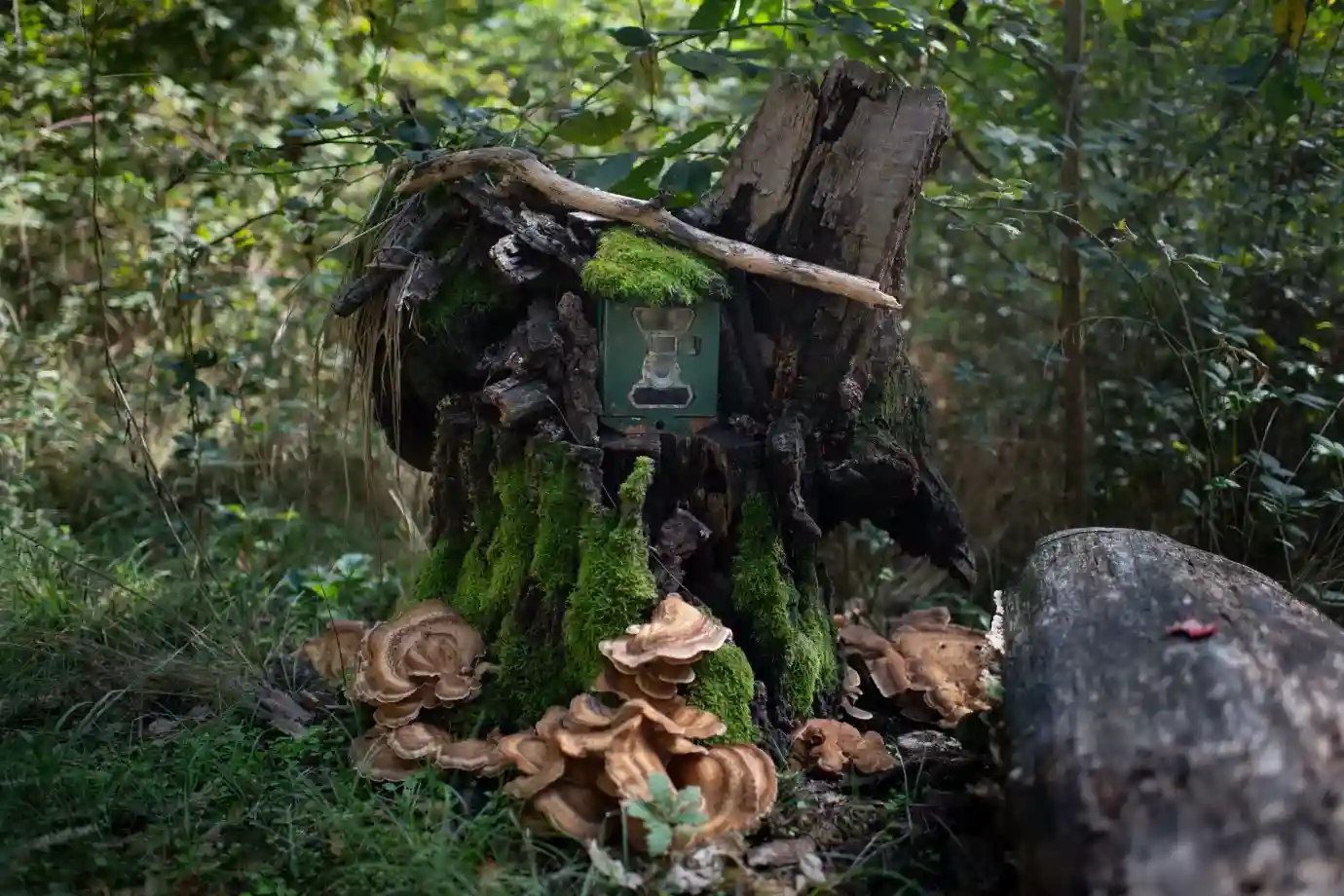
Dead trees are very important elements of a real living community, which provide a place for many species to live, feed and hide, approximately one third of forest communities are connected to them in some way. Rare wild cats, which are highly protected, also used to parade on such a felled, rotting tree, but foxes, nymphs and rabbits also like to visit this place. Different species of rodents regularly hide under the trunk of the tree, which are great prey for predators, but such trees are also teeming with insects, fungi, and various decomposing organisms. The habitat conversion was not specifically intended to favor one species, but the monitoring proved that several rare animal species found their way there thanks to the enrichment of the forest structure.
The first daytime wild cat recording was made in October 2022. Like their domestic relatives, these animals are also very curious, which is why one individual was able to look directly into the camera.
"All the infrastructural elements are examined, except for the hair trap, which could be used to check whether it is a valuable individual with genetically pure blood," said Major Borbála, DINPI's wildcat and large carnivore associate. Genetic sampling is not without reason, one of the biggest threats to wild cats is that they often mix with domestic cats, so there are more and more hybrid individuals. To stimulate rubbing against the fur trap, Major sprayed the board in front of us with catnip.
Wild cats have always lived in Börzsöny, and according to estimates, twenty to thirty individuals are still in the area. They have a large range of movement, covering one hundred to two hundred hectares. A male and a female wild cat are present in the sample area, they only meet during the breeding season. Then they find each other with their wedding song.
"Our little soft-footed friends really like to use these felled dead trees for fast travel instead of the dense undergrowth, and you can see that this is where the tabby used to sharpen its claws," Major said.
Two wild cat cubs have already appeared in front of the wildlife camera, and it has also been proven that their parents often go there. In one month, 73 pictures were taken of them, while only one wild cat was photographed in a control area.
The experts noted that there is also a great need for standing dead trees, and here they also helped a little, ringing some trunks, i.e. cutting around them with a saw to destroy the nutrient transport. Such decaying trees are quickly invaded by fungi and insects, and the latter are attacked by woodpeckers. Wild cats also like to visit the hollows of larger trees as a place to spend the day. One of the basic principles of the management of natural forests is that no wood is removed from them at all.
Pál Bódis, WWF's forest program expert, noted that the average age of forests in Hungary today is less than 45 years, which means that there are very few old, large trees. Out of the two million hectares of forests in Hungary, there are probably only a few thousand hectares, which really remind us of the natural forests of the past. "We need to support large trees because they are key to diversity in forest communities," he said.
Szekeres later said at a wooden methuselah, an oak tree that is at least 180 years old, that in a natural forest there should be twenty to sixty similar trees per hectare, but according to a forest inventory, on average there are only half a tree with a trunk diameter of more than fifty centimeters in Börzsöny. The Methuselahs are supported precisely because, for example, by barking the trees around them, they have a better chance of reaching the light and living longer. Years later, such solutions will no longer be needed, the natural forest dynamics will provide the leaves, dead trees, old specimens and species richness.
The fact that truly diverse habitats have been created within the project area was also proven by a rabbit that we disturbed. The marsupial predator sought shelter from us in the hollows of a standing dead tree, peered through the gaps, and then, sensing its cramped position, threw itself into the depths.
Bódis said that we have reached the point that in many cases it is not enough to protect a forest, but also to improve its naturalness. The sample areas can prove that significant results can be achieved even in a few years, which are considered a very short time in the life of a forest. The wild cats that appear, for example, indicate that their interventions have a beneficial effect on vertebrates.